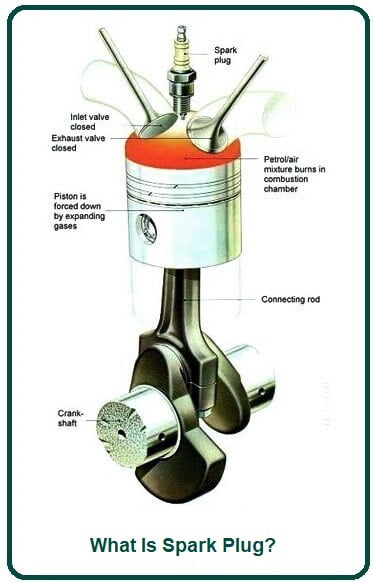
The spark plug is the device responsible for starting the combustion process in a gasoline engine.
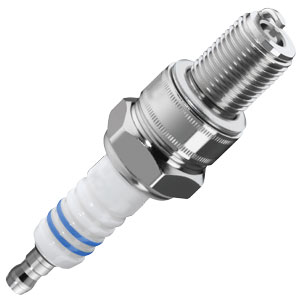
The spark plug has three primary layers. The outermost layer is a threaded metal shell that provides structural support.
The side electrode, which is grounded due to its connection to the metal casing, is connected to this shell on one end.
Inside the metal shell is a porcelain layer that serves as an insulator for the main electrode. The main electrode through which the current flows is housed within this insulated porcelain casing.
The porcelain casing completely electrically isolates this main electrode from the side electrode.
Construction Of Spark Plug
Ribs
Insulator ribs provide additional protection against secondary voltage or spark arcs while also assisting in improving the grip of the rubber electrical device boot against the plug body.
Insulator
Aluminum oxide ceramic is used to make the insulator body. An aggressive dry molding system is used to manufacture this component of the electrical device.
After molding, the insulator is kiln-fired to a temperature above steel's melting point.
This process yields a component with exceptional dielectric strength, high thermal conductivity and excellent shock resistance.
The spark plug insulator is indicated by the pointer. It is made of aluminum oxide ceramic, as previously stated.
The outer surface is ribbed to provide grip for the electrical device boot while also providing protection from spark arcs (crossfire).
Hex
A socket wrench can make contact with the hexagon.
The hex size is essentially uniform and is usually associated with the electrical device thread size.
Shell
Using a special cold extrusion method, the steel shell is manufactured to precise tolerances.
For the shell of certain types of spark plugs, a steel billet (bar stock) is used.
Plating
Almost always, the shell is plated.
This increases durability and provides resistance to rust and corrosion.
The steel shell is manufactured to precise tolerances using a special cold extrusion method or in some cases, machined from steel billet.
The polygon machined into the shell allows you to insert or remove the plug with a spanner.
Gasket
Certain spark plugs have gaskets, while others are gasket less.
The seal used on spark plugs could be a sunray steel style with a swish surface for waterproofing purposes.
A tapered seat shell seals a gasket less electrical device via a detailed tolerance incorporated into the spark plug.
Threads
Spark plug threads are typically rolled rather cut.
This satisfies the specifications established by the SAE and the International Standards Association.
Ground electrode
Ground electrodes come in a variety of shapes and configurations, but they are almost always made of nickel alloy steel.
Under massive temperature extremes, the ground conductor should be resistant to both spark erosion and chemical erosion.
Center electrode
Center electrodes should be manufactured in a special alloy that is resistant to spark erosion and chemical corrosion.
Keep in mind that the temperatures in the combustion chamber vary (and sometimes radically). These conditions must be met by the center electrode.
Spark plug electrode gap
The gap is the space between the ground electrode and the center electrode.
Center electrodes must be made of a special alloy that is resistant to spark erosion as well as chemical corrosion.
Insulator nose
There are a wide range of material nose shapes and sizes available, but the insulator nose must be capable of shedding carbon, oil and fuel deposits at low speeds.
The insulator nose is generally cooled at higher engine speeds to reduce temperatures and electrode corrosion.
Working Principle of Spark Plug
At one end, the electrical device, like the generator or the induction coil, is connected to a high voltage supply. The other end, which contains the two electrodes, is placed in the combustion chamber.
A potential difference (voltage drop) is created between two electrodes when current flows through the terminal and into the main center electrode.
The gas mixture that fills the space between them acts as an insulator, preventing electricity from flowing beyond the tip of the center electrode.
However, as the voltage rises, the gases in the gap become energized. When the voltage exceeds the dielectric strength (resistance to conduct electricity) of the gases, they become ionized.
When the gases become ionized, they begin to act as conductors, allowing current to flow through the insulating gap.
Electrons begin to surge through the gap when the dielectric strength is crossed. This sudden movement of electrons rapidly raises the temperature in that region, causing them to expand rapidly, resulting in a mini-explosion and the formation of a spark.
Spark Plug Types
Spark plugs can be divided into two primary categories based on their operating temperatures and construction.
Based on Operating Temperatures
The heat generated by the combustion process must be dissipated once the combustion process is completed in the combustion cycle.
The heat escapes through the exhaust gases, the engine's cylinder wall and the spark plug surface.
Spark plugs are classified into two types based on their operating temperature and heat dissipation level :
Hot Spark Plug
A hot spark plug works at higher temperatures.
It has a smaller ceramic area that is used to insulate heat.
A hot spark plug dissipates less combustion heat, allowing the tip and electrode to remain hotter for longer.
This ensures that any deposit accumulation is burned off and is not allowed to remain for an extended period of time.
Cold Spark Plug
Using a hot spark plug on a high-performance engine that runs hot by default will result in pre-ignition.
It can also result in the tip melting off in extreme cases.
A cold spark plug is used in such cases, because the ceramic insulation area is larger here, it will dissipate more heat.
On the other hand, it is more prone to deposit accumulation.
Based on Material Used
The material used on the ends of the electrodes is used to further classify spark plugs. They are classified into four types :
Copper-Nickel Type
These are the most fundamental kinds of spark plugs, because copper is very weak on its own and will melt off due to engine heat, the center electrode in this case is made of a copper-nickel alloy.
Even though nickel is added to strengthen the plug, these are the weakest types on the market.
They must also have a larger diameter and as a result, require more voltage to operate.
Single Platinum Type
On the tip of the center electrode of these plugs is a small platinum disc, because a platinum tip is exponentially stronger than a copper-nickel coating, this type of plug will last for a long time.
They are also less prone to debris accumulation.
Double Platinum Type
Both the center electrode and the side electrode of these plugs have platinum tips.
They light up twice during the combustion cycle, once before and once during the exhaust stroke, because the second spark is wasted, this spark plug can only be used if your vehicle has a waste spark ignition type distributor.
Iridium Type
These are the most effective spark plugs on the market.
The tip of the center electrode is made of Iridium, which is the most powerful metal among nickel, copper and platinum.
As a result, they are the least susceptible to deposits and damage.
They also have a smaller electrode that requires less voltage to operate.
Iridium plugs are significantly more expensive than the other types, but you get what you pay for.
Spark Plug Problems and Maintenance
The following are common indicators that spark plugs need to be replaced :
Rough Idling after starting your vehicle
The vehicle struggles to start the first time in the morning
Misfiring Engine
Enhanced fuel consumption
Reduced acceleration
Power surges that occur unexpectedly
Be wary of these warning signs, as driving your vehicle with a faulty spark plug causes improper combustion.
They begin to lose proper functioning even as they deteriorate.
This has the potential to damage various other parts of the engine.
However, with some simple routine maintenance, you can significantly extend the life of your vehicle's spark plugs.
This will allow you to save a significant amount of money that you would otherwise have to spend on replacing parts damaged by faulty spark plugs.
Simple Tips to Boost Spark Plug Life
Choosing the Right Type
It is critical that you select the correct type of spark plug for your vehicle before installing one.
If you use a cold spark plug in a low-performance engine, the heat will be dissipated too quickly, resulting in a delayed spark release.
Similarly, using a hot spark plug in a high-performance engine may cause the tip to melt away in the heat.
So, make sure to use the plug that is recommended for your vehicle's engine.
Clean off the Electrodes
Using a spark plug socket wrench, carefully remove the spark plug from its terminal.
Soak the plug in a thinner liquid, such as diesel, gasoline or an isopropyl alcohol solution.
Using a toothbrush or sandpaper, remove the hard, crusted deposit from the electrodes.
If the deposit is too difficult to remove, a wire brush can be used, but it is not highly recommended.
Check the Spark Gap
The spark gap between the two electrodes is extremely important.
The spark will be very weak if the gap is too small. If there is too much, there may be no spark at all.
Change the gap width with a coin/wire-coin type gap measure and make any necessary adjustments.
Adjusting the gap of the side electrode should be done with extreme caution because it can easily snap off.
Clean off the Mounting Area
As an added bonus, clean the area where the spark is mounted.
The building of combustion debris on the gap can cause the spark plug to become misaligned.
Wipe away all debris and oil from that area before reinstalling the spark plug.




0 Comments